
The direction of development
If 2025 was the year of AI, 2026 will be the year of Agentic AI.
The use of AI is expanding beyond simple document drafting toward increasingly complex chains of actions. While the document remains at the core of legaltech products, new solutions are emerging alongside it — supporting profitability tracking and conflict-of-interest checks through automated, multi-step processes.
Time savings can be found beyond document creation.
Agentic AI also enhances document drafting by enabling highly complex query and analysis structures as a foundation for documents — without requiring users to really understand prompting.
A good example can be found in our own portfolio. Not all solutions aim to produce documents.
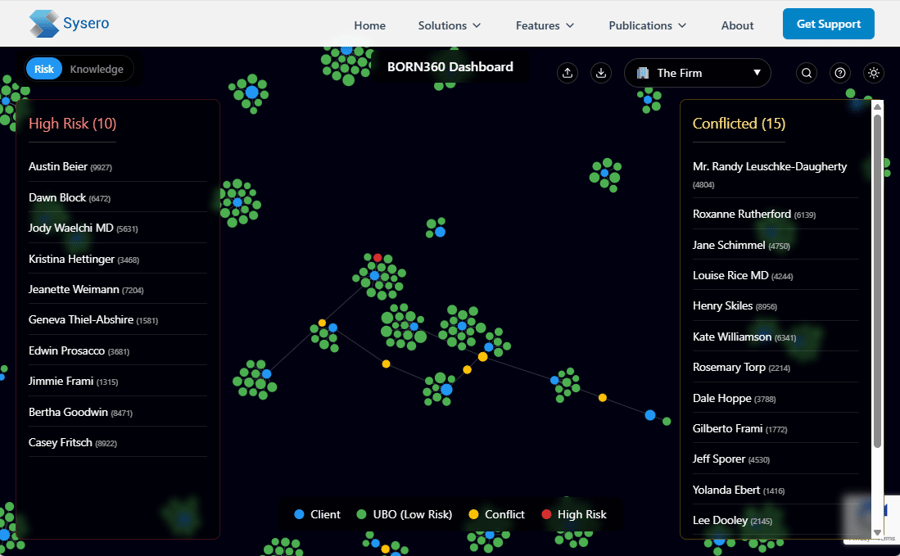
Sysero Compliance & Onboarding uses Agentic AI in conflict-of-interest checks by leveraging multiple data sources. What makes this product particularly distinctive is the network graph it creates of connections between matters, companies, and individuals. The color-coded nodes make it easy to identify areas that require closer review.
Another example is Litera Foundation Scoping, which, based on hourly rates and their explanations, is able to build up a good picture of what each company does, when it does it, where it does it and at what cost. Here too, natural language queries are used.
In addition to Agentic AI, the term Model Context Protocol (MCP) is on the rise. This protocol allows data to be queried and communicated in a standard way with other MCP-enabled systems, reducing the need to move data into the tool's own storage to perform AI tasks. Data security will be improved, access rights will be better respected and chains can be increasingly complex. MCP support will be the lifeblood of tools in the industry in the future.
Change or turning point?
It seems we’ve come full circle in how we select tools. Since virtually all tools now include AI features, it no longer makes sense to choose or procure “AI tools” as such. Instead, we select the best tool for each purpose and evaluate how well its AI capabilities support the core task.
A tool must function in the environment where work happens — while never forgetting the essentials of the legal industry: security, regulatory compliance, minimal hallucination, genuine source references, and ensuring data remains within the organization.
The shift is also visible in my own way of working. In addition to centralized document management in iManage Work, I use several different AI tools in slightly different places for different purposes. I’ve almost completely stopped using Google searches, as reviewing results often feels like a laborious process. In some situations, traditional search is still the fastest option, but increasingly AI replaces it — or at least significantly improves the outcome.
Today, Litera Lito AI summarizes emails and compares attachments directly in Outlook. Lito also assists in evaluating and drafting individual documents in Word. It is compatible with iManage Work.
Microsoft Teams Facilitator creates meeting summaries and does an excellent job of extracting key points even from long calls. I always review the summaries myself but rarely find anything to correct. Occasionally a follow-up task is assigned to the wrong person, but otherwise the accuracy is excellent.
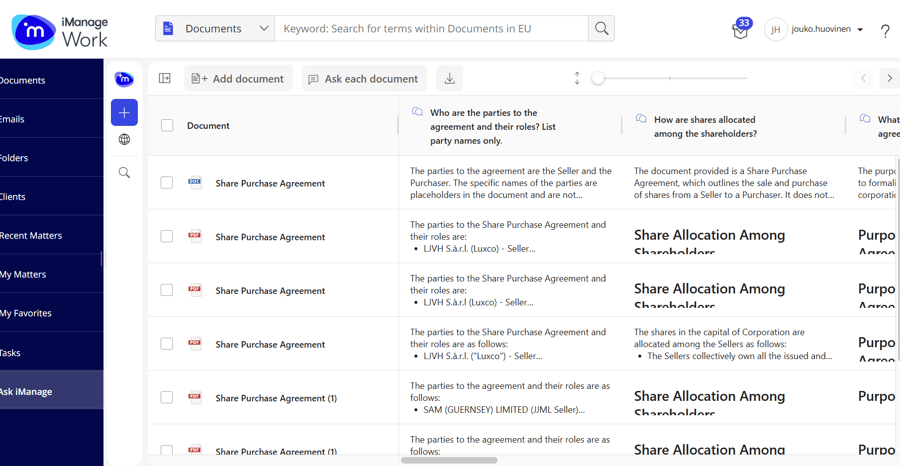
Ask iManage within document management is essentially a next-generation search function and, in my opinion, indispensable for all users. Natural language searches, the ability to process large document sets without transferring data from its original location, and the option to use question lists to analyze document collections add tremendous value. Emails stored in iManage can also serve as sources for queries.
Advania Private AI Platform (PAIP) acts in my daily work as a trusted internal expert. It answers my questions about ICT and HR guidelines, provides sales materials, and helps create communications texts. We have even more agents in internal use within our company, and an even larger number in customer environments.
Microsoft Copilot, in turn, explains Excel formulas, supports PowerPoint usage, provides PowerShell code examples, and answers more general questions that were previously directed to search engines.
My personal use may not be revolutionary, but I’m genuinely pleased with how these different tools make my work easier. And more is constantly coming — because all the tools I use continue to evolve.